Semantic color
12 variablesInk / strong
#0B1F3AAction / primary
#1769E0Action / subtle
#DCE8FFStatus / success
#087A55Status / critical
#B33A2BSurface / canvas
#F4F7FBModernizing supplier systems through Angular architecture, reusable interface patterns, and close collaboration with product, UX, QA, and engineering.
Supplier systems carried quality, sourcing, and performance workflows across a global organization. The modernization effort moved legacy JSP interfaces toward Angular frontends and service-based integration. A useful design standard had to survive different product requirements, teams, and releases.
Jeff’s role joined interface architecture with delivery: reusable Angular components, state-management patterns, API conventions, UI specifications, stakeholder workshops, workflow refinement, and release readiness.
Make related applications feel coherent while allowing each to express its own business rules. A shared visual language had to be supported by shared behavior, clear requirements, and maintainable implementation.
Align product owners, subject-matter experts, suppliers, UX, QA, support, and engineering around decisions that could be implemented and reviewed consistently.
The screens, records, code, and workflow below were created for this portfolio in 2026. They illustrate the approach using fictional supplier-quality cases; they are not original GM screens, code, or research artifacts.
The representative task is straightforward: find a case, understand its context, assign the next action, and know whether the update was saved. That task exposes the difficult interface decisions that feature lists tend to hide.
#0B1F3A#1769E0#DCE8FF#087A55#B33A2B#F4F7FBPrimary / DefaultSecondary / DefaultDanger / DefaultPreserve the draft after a rejected write.
Explain the outcome without exposing service language.
Keep recovery local to the action that failed.
Interactive board: click Foundations / Components / States above to switch panels. Not a Figma file — a static reconstruction of one.
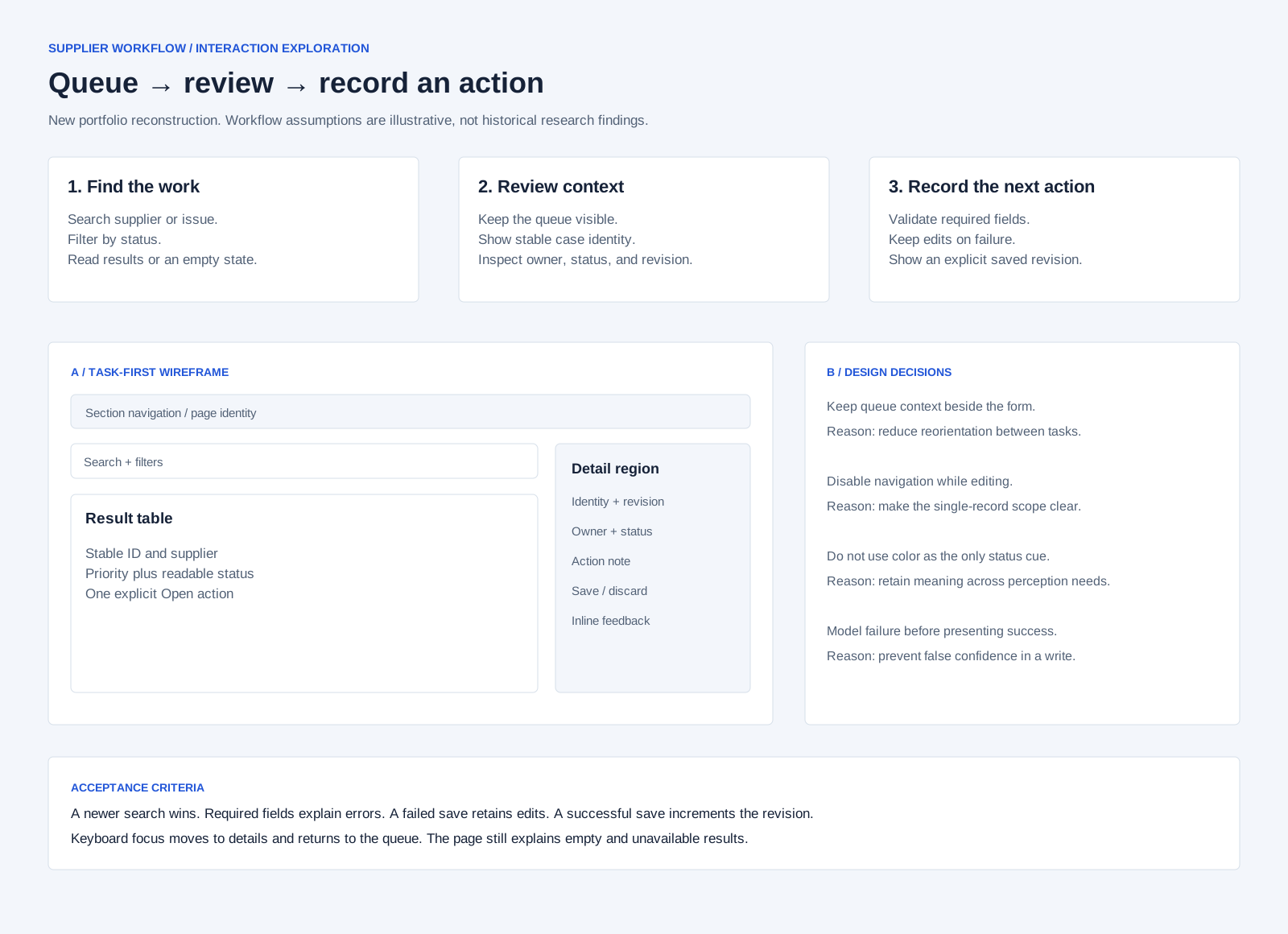
| Decision | User benefit | Tradeoff |
|---|---|---|
| Keep the queue beside the editor. | Retain orientation while reviewing a case. | The detail region stacks below the queue on narrower screens. |
| Keep one record in edit scope. | Make ownership of unsaved changes clear. | Filters and other Open actions pause until the editor closes. |
| Use labels with status colors. | Status remains understandable without color perception. | Requires room for explicit text in dense tables. |
| Use a deliberate save action. | The person knows when a change is submitted. | Needs dirty, saving, failure, and success states. |
| Preserve edits after a failed save. | A service failure does not make the person repeat their work. | Form draft state must be separate from saved records. |
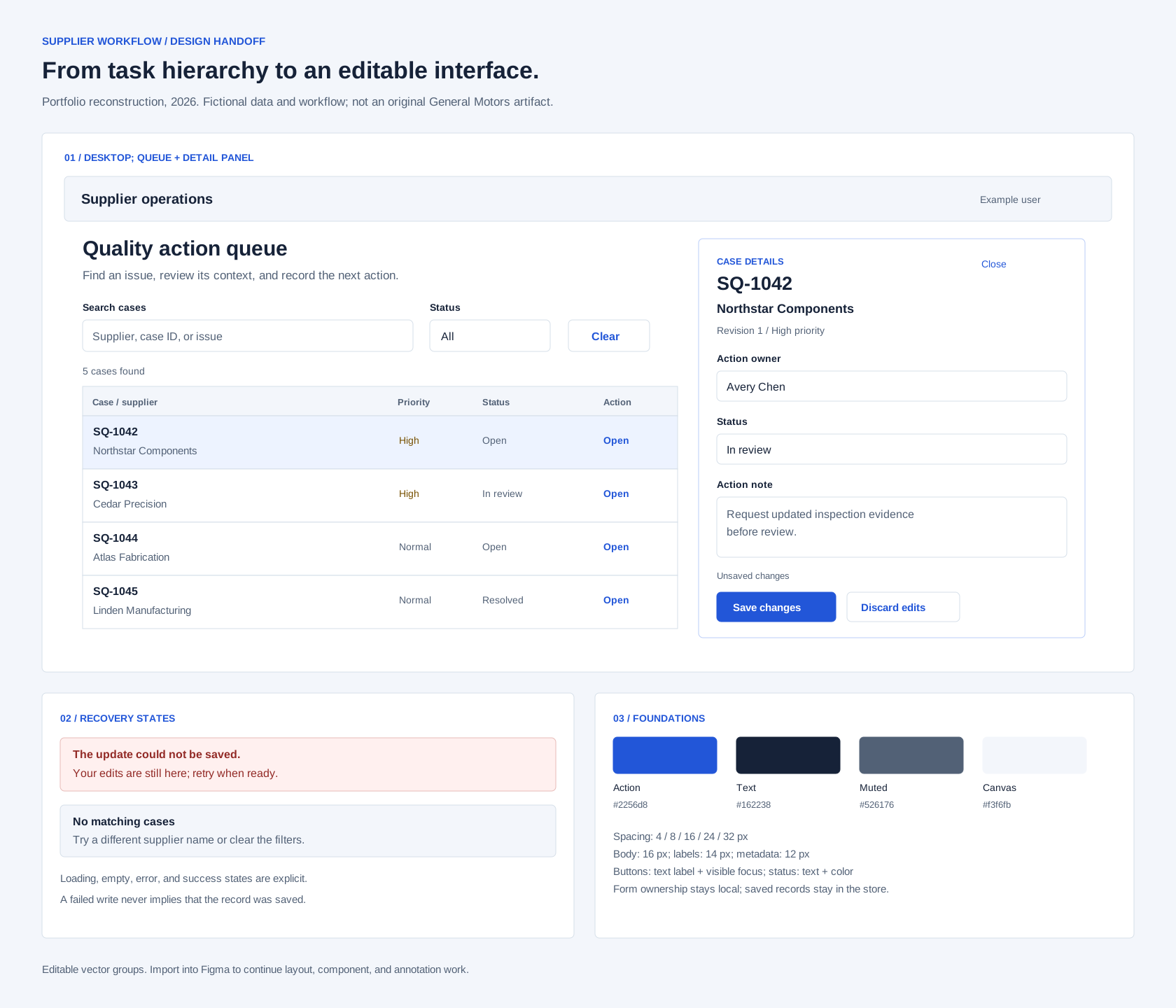
SVG files contain editable shapes, text, and named groups for Figma import. They are not native Figma files or historical project deliverables.
A deliberately bounded prototype, separate from the full Angular reference implementation in the next section. Choose a case, update its owner or action, and test successful and failed saves without losing the draft.
Vanilla JS, not the Angular build below — a lightweight inline taste of the interaction before the full NgRx implementation.
The reference implementation uses Angular 16, NgRx Store and Effects, RxJS, typed reactive forms, and OnPush components. The version aligns with the later period of the enterprise work. This newly authored example is a demonstration, not a production dependency recommendation.
The store holds saved records and request status. The typed reactive form owns the draft. A save error changes the feedback, not the input values. A successful save returns a revised record and resets the form to that new baseline.
Search uses switchMap so a newer query replaces an older request. Save uses exhaustMap so repeated clicks cannot submit multiple writes while one is pending. Errors are caught inside each request stream so later actions still work.
A real API integration would replace the mock service behind this boundary. Request types describe the contract; runtime response validation, authorization, idempotency, and revision enforcement still belong at the appropriate client and server boundaries.
effects.tsSearch cancellation, explicit save concurrency, and recoverable request streams.
import { Injectable, inject } from '@angular/core';
import { Actions, createEffect, ofType } from '@ngrx/effects';
import { catchError, exhaustMap, map, of, switchMap, timer } from 'rxjs';
import { DemoCasesApi } from './demo-api';
import * as Cases from './state';

@Injectable()
export class CasesEffects {
  private readonly actions$ = inject(Actions);
  private readonly api = inject(DemoCasesApi);

  // A new query immediately cancels the old debounce and the old request.
  load$ = createEffect(() => this.actions$.pipe(
    ofType(Cases.queryChanged),
    switchMap(({ query }) => timer(180).pipe(
      switchMap(() => this.api.search(query)),
      map(items => Cases.loadSucceeded({ items })),
      catchError((error: Error) => of(Cases.loadFailed({ message: error.message })))
    ))
  ));

  // Ignore repeated clicks until this submission settles. Do not auto-retry writes.
  save$ = createEffect(() => this.actions$.pipe(
    ofType(Cases.saveRequested),
    exhaustMap(({ update }) => this.api.update(update).pipe(
      map(item => Cases.saveSucceeded({ item })),
      catchError((error: Error) => of(Cases.saveFailed({ message: error.message })))
    ))
  ));
}
editor.component.tsA draft stays editable after failure. Required fields reject whitespace-only values.
import { ChangeDetectionStrategy, Component, EventEmitter, Input, OnChanges, Output, SimpleChanges } from '@angular/core';
import { CommonModule } from '@angular/common';
import { AbstractControl, FormControl, FormGroup, ReactiveFormsModule, ValidationErrors } from '@angular/forms';
import { CaseStatus, CaseUpdate, SupplierCase } from './models';

const meaningfulText = (minimum: number) => (control: AbstractControl): ValidationErrors | null =>
  String(control.value ?? '').trim().length >= minimum ? null : { meaningfulText: true };

@Component({
  selector: 'case-editor', standalone: true, imports: [CommonModule, ReactiveFormsModule],
  changeDetection: ChangeDetectionStrategy.OnPush,
  template: `
    <section class="editor" aria-labelledby="editor-heading">
      <div class="editor-heading"><div><p class="micro">CASE DETAILS</p><h2 id="editor-heading" tabindex="-1">{{ item.id }}</h2></div><button type="button" class="secondary" (click)="close.emit()" [disabled]="saving">{{ form.dirty ? 'Discard & close' : 'Close' }}</button></div>
      <p class="supplier-name">{{ item.supplier }}</p><p>{{ item.summary }}</p>
      <div class="revision">Revision {{ item.revision }} · {{ item.priority }} priority</div>
      <form [formGroup]="form" (ngSubmit)="submit()" novalidate>
        <fieldset [disabled]="saving">
          <label for="case-owner">Action owner</label><input id="case-owner" formControlName="owner" [attr.aria-invalid]="form.controls.owner.invalid && form.controls.owner.touched" aria-describedby="owner-help">
          <p id="owner-help" class="field-help" [class.validation]="form.controls.owner.invalid && form.controls.owner.touched">Enter at least 3 non-whitespace characters.</p>
          <label for="case-status">Status</label><select id="case-status" formControlName="status"><option>Open</option><option>In review</option><option>Resolved</option></select>
          <label for="case-note">Action note</label><textarea id="case-note" rows="4" formControlName="note" [attr.aria-invalid]="form.controls.note.invalid && form.controls.note.touched" aria-describedby="note-help"></textarea>
          <p id="note-help" class="field-help" [class.validation]="form.controls.note.invalid && form.controls.note.touched">Describe the next action or decision; at least 12 characters.</p>
          <p class="dirty" aria-live="polite">{{ form.dirty ? 'Unsaved changes' : 'No unsaved changes' }}</p>
          <div class="editor-actions"><button type="submit" [disabled]="saving || !form.dirty">{{ saving ? 'Saving…' : 'Save changes' }}</button><button type="button" class="secondary" (click)="reset()" [disabled]="saving || !form.dirty">Discard edits</button></div>
        </fieldset>
        <p class="feedback error" *ngIf="error" role="alert">{{ error }}</p>
        <p class="feedback success" *ngIf="notice" role="status">{{ notice }}</p>
      </form>
    </section>`
})
export class CaseEditorComponent implements OnChanges {
  @Input({ required: true }) item!: SupplierCase;
  @Input() saving = false;
  @Input() error: string | null = null;
  @Input() notice: string | null = null;
  @Output() save = new EventEmitter<CaseUpdate>();
  @Output() close = new EventEmitter<void>();
  readonly form = new FormGroup({
    owner: new FormControl('', { nonNullable: true, validators: [meaningfulText(3)] }),
    status: new FormControl<CaseStatus>('Open', { nonNullable: true }),
    note: new FormControl('', { nonNullable: true, validators: [meaningfulText(12)] })
  });
  ngOnChanges(changes: SimpleChanges): void {
    // Failures change only `error`; the user's unsaved form stays untouched.
    if (changes['item']) this.reset();
  }
  reset(): void { this.form.reset({ owner: this.item.owner, status: this.item.status, note: this.item.note }); }
  submit(): void {
    if (this.saving) return;
    this.form.markAllAsTouched();
    if (this.form.invalid) return;
    this.save.emit({ ...this.form.getRawValue(), id: this.item.id, revision: this.item.revision });
  }
}
state.tsSaved data and request state are explicit. A selector supplies the presentation model.
import { createAction, createReducer, on, props, createFeatureSelector, createSelector } from '@ngrx/store';
import { CasesState, CaseUpdate, Query, SupplierCase } from './models';

export const queryChanged = createAction('[Cases] Query changed', props<{ query: Query }>());
export const loadSucceeded = createAction('[Cases API] Load succeeded', props<{ items: readonly SupplierCase[] }>());
export const loadFailed = createAction('[Cases API] Load failed', props<{ message: string }>());
export const caseSelected = createAction('[Cases] Selected', props<{ id: string | null }>());
export const saveRequested = createAction('[Case editor] Save requested', props<{ update: CaseUpdate }>());
export const saveSucceeded = createAction('[Cases API] Save succeeded', props<{ item: SupplierCase }>());
export const saveFailed = createAction('[Cases API] Save failed', props<{ message: string }>());

export const initialState: CasesState = {
  items: [], query: { term: '', status: 'All' }, selectedId: null,
  loading: false, loadError: null, saving: false, saveError: null, notice: null
};
export const casesReducer = createReducer(initialState,
  on(queryChanged, (state, { query }) => ({ ...state, query, loading: true, loadError: null, selectedId: null, saveError: null, notice: null })),
  on(loadSucceeded, (state, { items }) => ({ ...state, items, loading: false })),
  on(loadFailed, (state, { message }) => ({ ...state, items: [], loading: false, loadError: message })),
  on(caseSelected, (state, { id }) => ({ ...state, selectedId: id, saveError: null, notice: null })),
  on(saveRequested, state => ({ ...state, saving: true, saveError: null, notice: null })),
  on(saveSucceeded, (state, { item }) => ({ ...state, saving: false, items: state.items.map(row => row.id === item.id ? item : row), notice: `Saved ${item.id}. Revision ${item.revision}.` })),
  on(saveFailed, (state, { message }) => ({ ...state, saving: false, saveError: message }))
);
const selectCases = createFeatureSelector<CasesState>('cases');
export const selectViewModel = createSelector(selectCases, state => ({
  ...state,
  visibleItems: state.items.filter(row => state.query.status === 'All' || row.status === state.query.status),
  selected: state.items.find(row => row.id === state.selectedId) ?? null
}));
demo-api.tsThe local service simulates latency, one-time failures, validation, and stale-write rejection.
import { Injectable } from '@angular/core';
import { Observable, timer, map } from 'rxjs';
import { FIXTURES } from './data';
import { CaseUpdate, Query, SupplierCase } from './models';

@Injectable({ providedIn: 'root' })
export class DemoCasesApi {
  private rows = FIXTURES.map(row => ({ ...row }));
  failNextLoad = false;
  failNextSave = false;

  search(query: Query): Observable<readonly SupplierCase[]> {
    return timer(450).pipe(map(() => {
      if (this.failNextLoad) { this.failNextLoad = false; throw new Error('The queue could not be loaded. Retry with your filters intact.'); }
      const term = query.term.trim().toLowerCase();
      return this.rows.filter(row => (!term || `${row.id} ${row.supplier} ${row.summary}`.toLowerCase().includes(term)) && (query.status === 'All' || row.status === query.status)).map(row => ({ ...row }));
    }));
  }

  update(update: CaseUpdate): Observable<SupplierCase> {
    return timer(600).pipe(map(() => {
      if (this.failNextSave) { this.failNextSave = false; throw new Error('The update could not be saved. Your edits are still here; retry when ready.'); }
      const index = this.rows.findIndex(row => row.id === update.id);
      if (index < 0) throw new Error('The selected case no longer exists.');
      if (this.rows[index].revision !== update.revision) throw new Error('This record changed. Reopen it before submitting a new update.');
      if (update.owner.trim().length < 3 || update.note.trim().length < 12) throw new Error('Enter an owner and a clear action note.');
      const item = { ...this.rows[index], ...update, owner: update.owner.trim(), note: update.note.trim(), revision: update.revision + 1 };
      this.rows = this.rows.map((row, position) => position === index ? item : row);
      return { ...item };
    }));
  }
}
Requirements refinement, acceptance criteria, UAT coordination, defect triage, architecture reviews, and rotating production support connected design decisions to working systems. Shared components and standards were adopted across product teams, with mentoring for more than 40 developers.
Jeff’s career materials report an approximately 30% improvement in delivery velocity. That is an engagement outcome; no such result is claimed for this reconstruction.
Strict Angular template compilation checks the component contracts. Six automated checks exercise the reconstructed workflow’s failure and concurrency behavior.
For this reconstructed workflow, the proposed measures are time to find the right case, successful update rate, validation corrections, recovery after service failure, and keyboard task completion. These are a proposed evaluation plan, not invented research results.